


Coastal surveillance comes with challenges that standard security cameras may not handle well. Salt spray, changing weather, low light, long detection distances, and constant vessel movement can all affect monitoring performance. For ports, coast guard facilities, offshore platforms, and maritime security operators, choosing the right camera is about more than image quality. The system must provide reliable visibility, accurate target observation, and practical control in demanding marine environments.
A Maritime Dual PTZ Camera combines visible-light and thermal imaging in one pan-tilt-zoom platform. This allows operators to observe a scene in daylight, detect heat signatures in darkness, and zoom in on potential targets when closer inspection is needed. However, different coastal projects require different specifications. Understanding the main selection criteria will help you choose a system that fits your surveillance area, operating conditions, and integration requirements.
1. Understand Your Coastal Surveillance Requirements
Before comparing camera models, define what the system needs to monitor. A busy commercial port has different priorities from an offshore energy platform or a long stretch of coastline.
- Port and harbor security: Monitor vessel movements, berths, restricted areas, and waterfront infrastructure.
- Coastal perimeter surveillance: Detect and observe vessels approaching designated areas, including during nighttime operations.
- Offshore platforms: Monitor surrounding waters and critical infrastructure in exposed marine conditions.
- Search and rescue: Help operators locate vessels or people through thermal observation when visibility is limited.
- Commercial vessel operations: Improve situational awareness during navigation, approach, and docking.
Consider the required detection distance, the width of the surveillance area, the number of targets that may appear simultaneously, and whether operators need continuous monitoring or occasional inspection. These details determine the appropriate lens, thermal resolution, pan-tilt range, and control features.
2. Choose a Dual-Sensor Camera for Day and Night Monitoring
A key advantage of a Maritime Dual PTZ Camera is the combination of optical and thermal imaging. Each sensor provides different information, making them useful for different stages of surveillance.
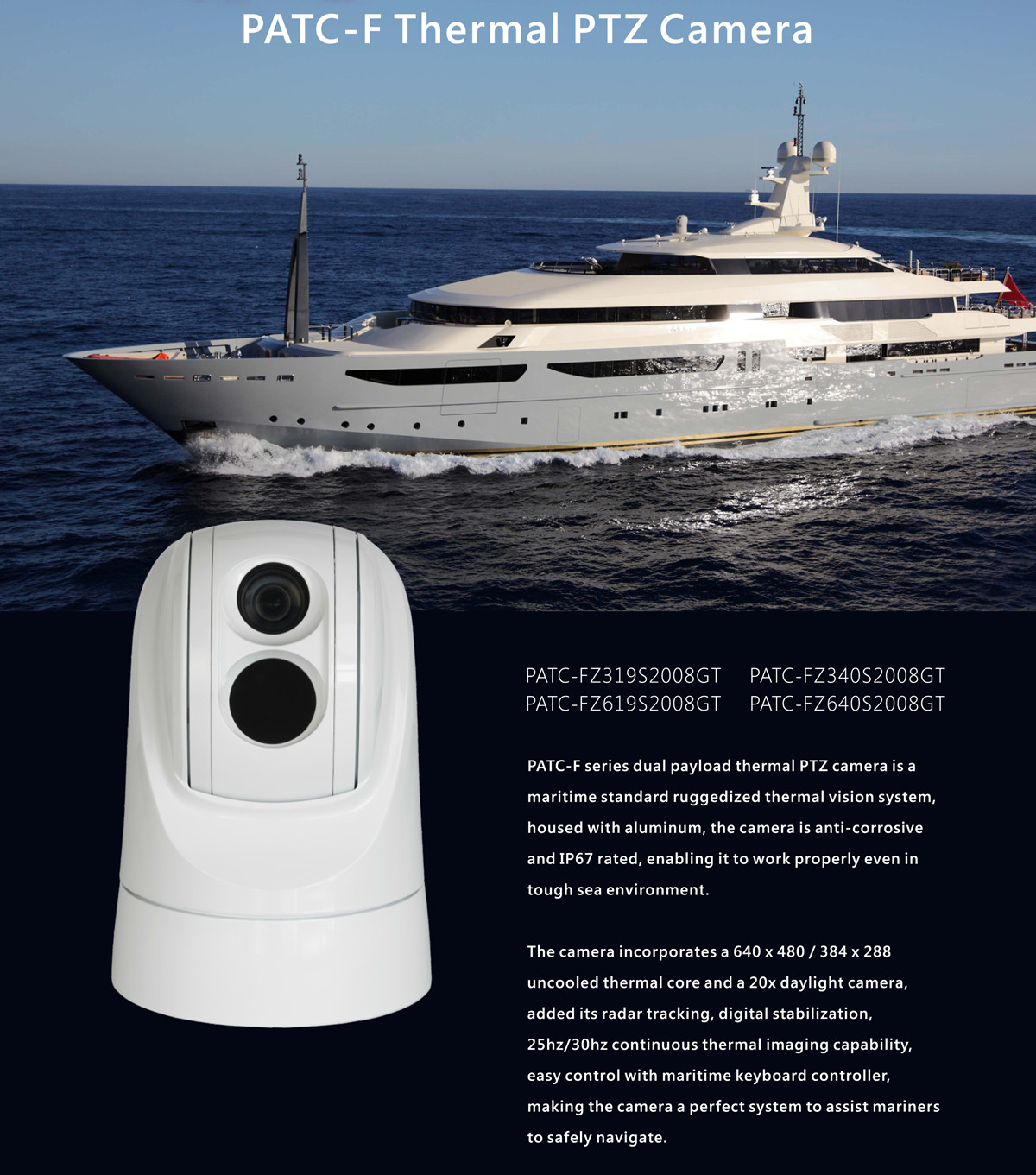
WINSAFE PATC-F Series dual-payload thermal PTZ camera for marine surveillance.
Visible-light imaging provides recognizable visual details, such as vessel outlines, deck activity, navigation lights, and other scene characteristics. Optical zoom helps operators inspect distant targets without moving the camera installation.
Thermal imaging detects differences in infrared radiation rather than relying on visible light. It can help reveal warm objects, vessels, and people against cooler backgrounds, even in complete darkness. Its effectiveness still depends on target size, thermal contrast, atmospheric conditions, and the camera's sensor and lens specifications.
For coastal monitoring that operates around the clock, combining these two imaging methods can provide more useful information than relying on either one alone. Explore the Maritime Thermal PTZ Cameras range to compare available dual-payload solutions.
3. Compare Thermal Resolution, Lens Options, and Detection Range
Thermal resolution is one of the first specifications buyers should compare. A higher-resolution sensor can provide more image detail, but resolution alone does not determine how far away a target can be detected or identified.
The WINSAFE PATC-F Series offers thermal configurations including 384 × 288 and 640 × 480, depending on the model. The product range also combines thermal imaging with a daylight camera and supports long-range observation features.

Marine installation example for a rugged thermal PTZ camera.
When evaluating a Thermal PTZ Camera, check the following specifications:
- Thermal resolution: Higher pixel counts can help reveal more target detail at a comparable distance.
- Lens and field of view: Narrow fields of view support long-range observation, while wider views cover more of the surrounding area.
- Detection and recognition range: Check the manufacturer's figures for the specific sensor and lens combination.
- Optical zoom: Confirm the daylight camera's optical zoom ratio and focal-length range.
- Frame rate: A suitable thermal frame rate supports smooth observation of moving vessels and other targets.
Detection, recognition, and identification are not the same. A camera may detect that an object is present without providing enough detail to determine what the object is. Ask suppliers for range calculations based on your target size, installation height, and environmental conditions rather than choosing a camera by resolution alone.
4. Check Marine-Grade Protection and Image Stabilization
Saltwater environments are demanding on electronic equipment. A camera installed on a pier, ship, or offshore platform may face salt spray, rain, high humidity, vibration, and temperature changes throughout the year.
Look for a corrosion-resistant housing, suitable ingress protection, and a working temperature range that matches the installation site. An IP67 rating indicates defined protection against dust and temporary immersion under specified test conditions. It does not automatically guarantee resistance to every marine exposure, so corrosion protection and installation requirements should also be reviewed.
Image stabilization is another useful feature. Wind, waves, and vessel movement can cause the camera image to shake, particularly when using a narrow field of view at high magnification. Digital or gyro-based stabilization can help maintain a more stable view, depending on the implementation.
The WINSAFE PATC-F Series features an aluminum housing, corrosion-resistant construction, IP67 protection, and digital stabilization. Review the manufacturer's specifications to confirm that the selected configuration suits your application and mounting conditions.
5. Evaluate PTZ Movement, Tracking, and System Integration
Pan, tilt, and zoom performance determines how effectively operators can inspect different parts of the surveillance area. A camera with continuous 360-degree pan movement can cover a broad horizontal area, while programmable presets help operators return to important locations quickly.
For larger coastal installations, consider whether the camera supports:
- Programmable viewing presets and adjustable movement speeds.
- Automatic target tracking, where supported by the selected model.
- Radar cueing or radar-based target positioning, if required by the project.
- Compatible video outputs and network protocols.
- Integration with existing monitoring software, displays, or recording systems.
Some PATC-F configurations support optional radar tracking and video tracking. These features can help direct the camera toward a target or keep it centered in the image, depending on the selected configuration and system integration.
Do not assume that every camera supports every tracking or integration feature. Confirm the exact model, software requirements, interface compatibility, and any optional hardware before finalizing the system design.
6. Select a Marine Control Keyboard That Fits the Installation
Even a capable camera can be difficult to operate if its controls are inconvenient or incompatible with the rest of the system. A Marine Control Keyboard gives operators a dedicated interface for moving the camera, adjusting zoom, selecting presets, and accessing supported functions.

MKB-01 maritime keyboard controller in a vessel control environment.
For marine installations, pay attention to control interfaces, communication protocols, button visibility, joystick precision, and environmental protection. The WINSAFE MKB-01 Maritime Keyboard Controller supports RS485 and Ethernet interfaces, with Pelco-D and Pelco-P protocol compatibility listed by the manufacturer. Its three-axis joystick, OLED display, and backlit keys are useful considerations for low-light operating environments.
Before ordering, confirm that the keyboard and camera share a compatible interface and protocol. Also check cable length, power requirements, supported commands, and whether the controller can operate all the functions your operators need.
7. Consider the Complete Marine Thermal Imaging System
For a coastal surveillance project, buying a camera in isolation may overlook important integration details. A complete Marine Thermal Imaging System may include a dual-sensor PTZ camera, control keyboard, mounting hardware, power supply, video transmission equipment, displays, and connections to a wider security or monitoring platform.

Marine thermal imaging solution combining a thermal PTZ camera and control keyboard.
Before selecting a solution, establish how video will reach the monitoring room, how the camera will receive control commands, and whether operators need to record footage or connect to radar and other sensors. For remote locations, network reliability and maintenance access should also be part of the design.
Ask the supplier to confirm the complete bill of materials, interface requirements, installation conditions, and compatibility of all components. A system-level review can help reduce commissioning issues and avoid purchasing accessories that do not work with the selected camera.
8. Compare Solutions Before Making a Final Decision
Use the following checklist when comparing maritime camera suppliers:
- Does the system combine visible-light and thermal imaging?
- Are the thermal resolution, lens options, and target ranges suitable for the site?
- Is the housing designed for the expected salt spray, rain, and vibration?
- Are stabilization and tracking functions available where required?
- Can the camera integrate with the existing control and video systems?
- Is a compatible marine keyboard available?
- Can the supplier provide technical documentation and configuration support?
For ports, offshore facilities, and coastal security projects, the right choice depends on the balance between imaging performance, environmental protection, control convenience, and integration cost. A carefully specified system is more useful than simply selecting the model with the highest zoom ratio or thermal resolution.
WINSAFE provides maritime thermal PTZ camera solutions and related control equipment for marine surveillance applications. Visit the WINSAFE official website to review its product range or contact the team with your required detection distance, operating environment, and system interface specifications.
Frequently Asked Questions
1. What is a Maritime Dual PTZ Camera?
A Maritime Dual PTZ Camera combines visible-light and thermal sensors in a pan-tilt-zoom platform. It supports daytime observation, nighttime thermal monitoring, and remote inspection of vessels or objects across a marine surveillance area.
2. Is a Thermal PTZ Camera suitable for coastal surveillance at night?
Yes. Thermal imaging detects infrared radiation and does not depend on visible light in the same way as conventional cameras. It can help operators observe vessels and people at night, although performance depends on thermal contrast, sensor resolution, lens selection, and weather conditions.
3. What thermal resolution should I choose for maritime monitoring?
The appropriate resolution depends on the target size, required observation distance, and level of detail needed. Compare sensor resolution alongside lens specifications, field of view, and manufacturer-provided detection and recognition ranges.
4. Why is IP67 protection important for marine cameras?
IP67-rated equipment provides defined dust protection and protection against temporary immersion under specified test conditions. For marine use, also assess corrosion resistance, mounting, cable sealing, temperature limits, and the manufacturer's installation guidance.
5. Do I need a Marine Control Keyboard?
A dedicated marine keyboard can make PTZ movement, zoom adjustment, preset selection, and camera operation easier. It is particularly useful for control-room or bridge installations, provided its interfaces and protocols are compatible with the camera.
6. Can a maritime thermal camera integrate with radar?
Some models support radar-based target cueing or tracking through compatible interfaces and software. Check whether the selected configuration includes this function, which radar data format is required, and whether additional integration work is necessary.
7. What information should I provide when requesting a quotation?
Provide the intended application, surveillance distance, target types, mounting location, environmental conditions, required thermal resolution, optical zoom, control interfaces, and any radar or video-system integration requirements. These details help the supplier recommend a suitable configuration.


 +8613725587481
 sales@winsafecctv.com